
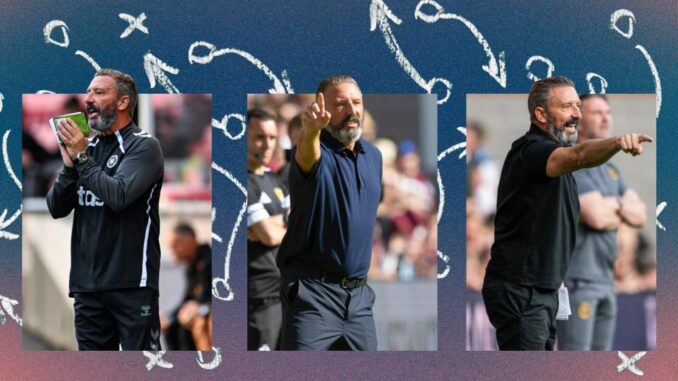
5 Hearts tactical observations from the League Cup.

We are four games into Derek McInnes’ reign as Heart of Midlothian head coach, and while there have been hints, it is unclear how he will set up his team. One thing is certain:
if the Premier Sports Cup group stage is any indication, he will not be afraid to make changes ahead of a game based on the opposition’s shape. McInnes will also make several in-game formation changes as needed.
There has been some progress in determining which players the Hearts manager will use from his sizable squad. There appears to be an established core, with few surprises.
McInnes has also revealed that he has the majority of his team in mind for the start of the Scottish Premiership season, with a few positions still available. The players are kept in the dark about it.
During the League Cup group stage, McInnes experimented with a variety of combinations while still producing results that should see Hearts advance to the next round.
With those games over and the Scottish Premiership opener less than a week away, Craig Cairns examines what we can learn from McInnes’ approach to the games.
Back three or back four?
Most formations are similar; the only significant difference is whether a team plays with a three-man or four-man defence.
Everything further up the pitch involves more subtle changes. A few yards difference here and there.
Even so, lines can be blurred, as was the case against Dumbarton on Tuesday night. Stephen Kingsley started on the left side of a back three, but when Hearts gained possession, he played more like a full-back or wingback.
A three-man defence is typically flanked by two wingbacks. When McInnes uses that shape, he prefers to use a winger on one side, or both.
Hearts began the game against Hamilton Academical with Alan Forrest and Christian Borchgrevink on the wings, with McInnes later stating that the intention was for them to be “ball carriers”. In contrast, when forming a back four, it is unclear how the full-backs will approach the game.
In the opening game against Dunfermline Athletic, Harry Milne made overlapping runs while Claudio Braga moved into central areas from the left.
However, against Striling Albion, the left-back was more likely to enter the centre of the pitch, allowing Alexandros Kyziridis to drop deep while remaining close to the touchline. Milne frequently made underlapping runs after that.
Depending on who is ahead of them in a back four, the full-backs may be instructed to support the winger, allowing them to stay high and/or wide. If they are more likely to come inside, the fullback will be asked to provide width.
Approach and set-pieces
Whether it’s two or three central defenders, Hearts have a lot of height on their side.
They scored a set-piece goal in each of their four group stage games, as well as two more in the second phase against Stirling.
Aside from Jamie McCart, who is injured, and Frankie Kent, all of the central defenders have already scored this season.
McInnes half-joked that the addition of set-piece coach Ross Grant was “his best signing” of the summer.
Hearts have, for the most part, advanced the ball quickly. Sometimes it was on the ground, and other times it was clearly in the air.
It is rarely an aimless punt or a shelling to a target man, though. Hearts don’t really have those types of forwards.

The game against Hamilton was an excellent example of this in action. When Accies pressed, the three Hearts centre-backs would not hesitate to look for a long pass.
If the opposing team sat back or there was space, Stuart Findlay, Kent, or Michael Steinwender would drive forward with the ball.
McInnes also wants his wide players to isolate defenders, create space, and deliver the ball into the box. This also increases the likelihood of more set plays and opportunities to place the ball in the box.
Front two
Hearts started two games with a four-man defence, but it was in a 4-4-2 formation. McInnes frequently sets up players to move into the No.10 position, but he does not usually start with someone in that position.
That is because he prefers to begin with a strike pairing. Convincing Lawrence Shankland to return was critical to this, and Hearts will begin the season with solid options. All four strikers who played in pre-season have scored.
Wilson and Braga have each scored twice, while Shankland has three. Frequently, one is told to extend the play. When Shankland plays, he is accompanied by his partner.
When Shankland was not at risk against Hamilton, James Wilson and Elton Kabangu started, meaning the former played slightly deeper.
McInnes could be heard demanding that whenever Hearts had the ball, one of them make a run in behind the opposing defence.
Kabangu, like imminent signing Pierre Landry Kabore, has the pace to be a threat here if he can avoid offsides.
The intention here is to latch on to through balls as much as it is about creating space for others to operate in. Shankland, for example, enjoys dropping into these spaces.
Spittal and Calem Nieuwenhof performed admirably against Accies, capitalising on the gaps that opened up.
Read more on sportupdates.co.uk
Leave a Reply