
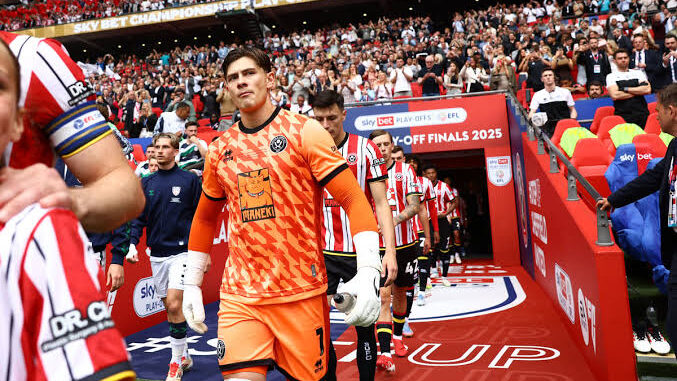
Sheffield United must find the correct balance in the transfer market as its owners make their future aspirations known.
Sheffield United’s new ownership group has made no secret of its approach to the transfer market in the future, but they must strike the proper balance as the Blades attempt to recover from last month’s defeat in the play-off final at Wembley. United are preparing for another huge summer after their promotion hopes were dashed under the arch.

Failure to secure an immediate return to the Premier League implies an uncertain future for some of its key players, with injured sensation Oliver Arblaster being linked with a move away this summer after Brighton and Hove Albion expressed interest. If concrete bids for Arblaster, Gus Hamer, and Vini Souza materialise, it might be the first major test of COH Sport’s leadership.
Their recent statement to supporters reassured them that the board was “working tirelessly to become stronger in the crucial area of recruitment… by using data and analytics far more effectively to recruit the best and brightest talent.”
The arrivals of Jefferson Cáceres and Christian Nwachukwu in the winter window sowed the first seeds of that approach, and ties with 21-year-old FC Sion defender Gora Diouf have all the makings of another data-driven purchase.
However, with Championship football notoriously difficult, particularly at the top level, United’s top brass must be cautious not to ignore the intangibles when identifying prospective new players. That is something United’s recruitment team has long wanted to do: combine physical output data with background checks on a player’s character and mentality.
It’s a technique that worked in the summer when Michael Cooper and Harrison Burrows were brought in as both personalities and players at Bramall Lane. Cooper was selected United’s player of the season, while Burrows made the Championship team of the year.
Sheffield United must attempt to strike the proper balance in recruitment ahead of the crucial transfer offseason.
United has always kept up with current recruitment tactics, employing analytics to appraise new players since Paul Mitchell was in charge of transfers. Yesterday, we documented how United attempted to sign future Dutch international Tijjani Reijnders for the 2022/23 season but were unable to complete the deal. The midfielder has agreed to join Manchester City for an initial fee of £42 million.
However, combining this with the old-fashioned “eye” on players is undoubtedly the greatest way to optimise United’s return on investment, which is where current head of recruiting Mikey Allen and chief scout Jamie Hoyland excel.
Supporters frequently propose that we ‘follow the Brentford and Brighton models’, both of which have problems. Brentford is primarily reliant on their owner’s data company, whereas Brighton has had both big triumphs and duds. Such strategies require long-term investment and patience, with the risk of losing sight of what is happening in the present.
“I know the narrative around the club at the moment is data-driven, and it’s the way forward, and ‘why not?'” stated manager Chris Wilder right before the season ended. “But there are always eyes, as well as objective and subjective points of view.
“And the delving into character. Michael’s persona is remarkable; we watched him and did extensive research on him. He’s been pretty good. Stephen Bettis did an excellent job of closing the deal.
Leave a Reply