
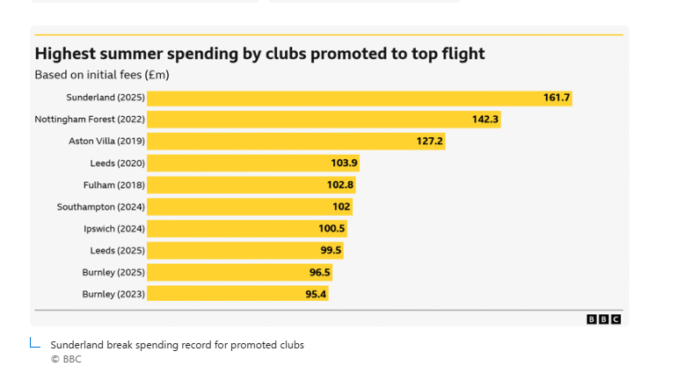
Sunderland have redefined the financial ambition of newly promoted Premier League clubs by committing £161.7 million to summer transfers—a record expenditure that surpasses Nottingham Forest’s previous high of £142 million in 2022. The Black Cats’ deadline-day acquisitions of Lutsharel Geertruida (on loan from RB Leipzig), Brian Brobbey (£17.4 million from Ajax), and Bertrand Traoré (£2.5 million) cemented an aggressive recruitment strategy designed to secure top-flight stability despite the growing competitive disparity between the Championship and Premier League.

Unprecedented Financial Commitment
Sunderland’s spending places them significantly ahead of other historic promoted spenders, including Aston Villa (£127 million in 2019) and Nottingham Forest. This approach reflects a broader trend among newly promoted clubs, who are investing increasingly substantial sums to bridge the quality gap. Last summer, Southampton, Ipswich, and Leicester collectively spent £276.5 million yet managed only 59 points—the lowest combined total for promoted sides in a 38-game Premier League season. Their struggles underscore the inherent risks of such investments, with no guarantee of on-field success.
Early Returns Suggest Strategic Acumen
Despite the financial gamble, early indications suggest Sunderland, Burnley, and Leeds—who have collectively exceeded £350 million in spending this window—may have allocated resources more effectively. The trio have accumulated 13 points in the opening fixtures, marking the strongest start by promoted clubs since the 2016-17 season. This contrasts sharply with last year’s promoted teams, who remained pointless at the same stage, highlighting that strategic recruitment, rather than expenditure alone, dictates survival prospects.
Historical Precedents and Future Implications
Forest and Villa’s successful stays after record investments offer optimistic precedents for Sunderland. However, the recent relegation of all three promoted clubs in consecutive seasons emphasizes the escalating challenges of top-flight consolidation. Sunderland’s strategy blends high-cost signings with targeted loans and experienced acquisitions, aiming to balance immediate impact with sustainable squad building. Whether this approach yields long-term success remains uncertain, but the early momentum suggests a calculated—rather than reckless—deployment of resources.
Leave a Reply