
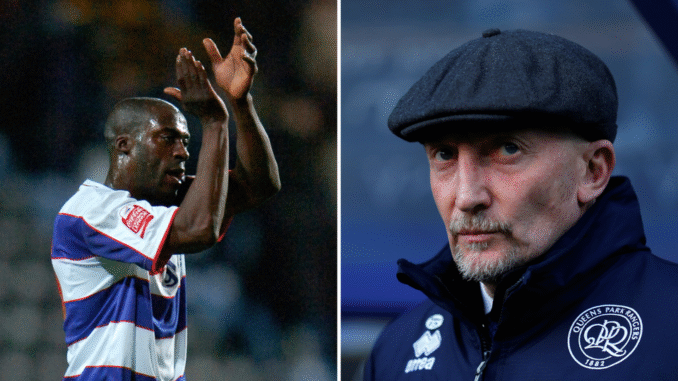
Paul Furlong, who was 34 when he joined Queens Park Rangers in 2002, would become a hero to the fans during his five years at Loftus Road.
Furlong’s career may have peaked at Queens Park Rangers, but it began in non-league football at the age of eighteen with Enfield in 1986, but his performances there impressed Coventry City enough for them to sign him in 1991 as a First Division club.
With only four goals in 37 games during his one season at Highfield Road, it appeared that he might not make the cut, but a move to Watford after one season worked out better for him, and Chelsea spent a then-club record £2.3 million on him in 1994.
After two years, he moved on once more, and Birmingham City paid a club-record £1.5 million to bring him to St Andrew’s. Before joining Queens Park Rangers in 2002, he spent six years with the team, scoring 50 goals in 130 Division One appearances.
When QPR bought Furlong, he was the player they could afford.
Prior to Furlong’s arrival at Loftus Road in 2002, QPR had experienced a disastrous run of years. They had been demoted from the Premier League in 1996 but had been unable to return, and in April 2001, they went into administration.
Relegation to the third tier occurred a few weeks later, for the first time since the 1960s. They hired Ian Holloway as manager in February 2001, and he stayed on after the relegation to rebuild the team, however in his first season, they finished eighth in the standings, nine points shy of a play-off spot.
Furlong was a free transfer from Birmingham, and with his 34th birthday approaching, he was what QPR could afford at the time, but he still scored 13 League goals in 33 games in his first season there, helping Rangers finish fourth in the table before losing the play-off final to Cardiff City at the Millennium Stadium.
| Paul Furlong’s Five Years at QPR | ||
|---|---|---|
| Season | Appearances | Goals |
| 2002/03 | 33 | 13 |
| 2003/04 | 36 | 16 |
| 2004/05 | 40 | 18 |
| 2005/06 | 37 | 7 |
| 2006/07 | 22 | 2 |
Figures from FBRef
But the following season, with Furlong paired up front by Kevin Gallen, Holloway struck the ideal balance, and QPR were promoted back to the Championship in second place behind Plymouth Argyle. Gallen scored 17 League goals that season, while Furlong scored 16, making them the division’s sixth and seventh highest scorers.
QPR supporters required players like Paul Furlong as their crisis persisted.
Furlong scored 18 goals as Rangers finished 11th in their inaugural season in 2005. However, the 2005–06 season was a complete bust for the squad due to accusations of violence and blackmail against Gianni Paladini, the club’s owner, and the murder of Kiyan Prince, a member of the junior team.
Rangers ended one spot above the relegation spots on the pitch. Furlong contributed six goals from 37 games that season, but he played a smaller role in what ended up being his final season with the team, scoring twice in 22 games in 2006–07. Furlong turned 38 in October 2006. At the end of that season, Paul Furlong left QPR for Luton Town after making 183 appearances across all competitions and scoring 58 goals for the team.
After playing for Southend United, he returned to non-league football, and in 2013, at the age of forty-four, he eventually retired from playing. He had returned to Loftus Road by this point and was managing their under-18 and under-23 teams as an assistant youth development coach. Darnell, his son, is currently a Championship player with West Bromwich Albion after playing for Rangers from 2014 to 2019.
Football teams require heroes, and Queens Park Rangers fans needed somebody to believe in when Paul Furlong came at Loftus Road in 2002. The club had been terribly governed, and it would remain so for years following his departure in 2007.
As crisis followed crisis poured over Loftus Road, supporters needed players that could do them proud on the pitch, and putting the team back into the Championship in 2004 mattered, at a club which hadn’t fallen that far in almost thirty years. Heroes come in different kinds and sizes, and in West London around the turn of the century, that shape was a huge, muscular striker who just kept on playing. Rangers fans will be overjoyed that he did.
Leave a Reply