
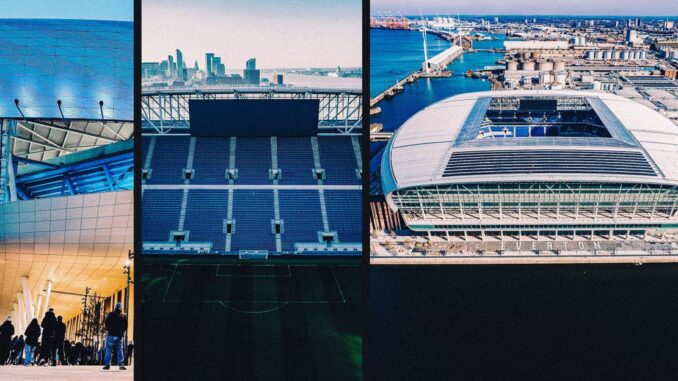
Behind the scenes at Everton’s new £800m stadium.
Everton’s new Hill Dickinson Stadium is a hub of activity. Cranes dominate the north Liverpool skyline on the day of The Athletic’s arrival.
One permits the installation of the first of four club crests, which will be placed on the far corners of the east and west stands. Other recent work has included putting the branding of naming rights partner Hill Dickinson, a successful local legal firm, on the roof.
The activity is urgent both inside and outside the stadium, which has a seating capacity of over 53,000 people. That is because the countdown to the new £800 million facility’s opening is well underway. In just over a month, Everton will host Italian side Roma in a pre-season friendly that will serve as the penultimate test event.
The club will host its debut Premier League game here against Brighton & Hove Albion in just over 50 days. The stadium is structurally complete. Dan Meis, the American architect who designed it, aimed to give the appearance that it had sprung from the pier on which it is located.
It’s easy to forget Hill Dickinson Stadium was literally built on sand. Construction took three and a half years, and the project was regarded as the largest single-site private sector development in the country.
The magnitude of the change has been astonishing. Four years ago, this was a semi-derelict site in a largely abandoned area of north Liverpool, a jaded, post-industrial relic from the city’s maritime history.
The infill took three months and entailed a dredger making 130 round trips over 20 miles out in the Irish Sea, collecting 480,000 cubic metres of sand from the sea bed before fluidising and pumping it into the dock. The stadium’s skeleton is built of around 12,500 tonnes of structural steel, seen predominantly on the north and south stands.
Numerous heritage assets have been protected and, in some cases, restored. Historic characteristics such as cobblestones and tramlines have been preserved. The walls of the current dock have been incorporated into the design, with surfaces visible in some areas.
Individual bricks had to be removed, recorded, and rearranged in the same order during the construction of the main supporter entrance.
The preservation of the wall ensures that, if necessary, the site can be converted again into a fully operational dock. The Grade II listed hydraulic tower and Engine House, which were built in 1883 and are located in the fan plaza in front of the east stand, have been renovated. Its future application is yet to be identified.
Initial plans included a museum of Everton memorabilia, however it appears that the area is too tiny to accommodate that. With the rooftop area converted into an outdoor space, it is feasible that the tower will become another bar.


The Athletic begins its tour in the West Stand, where Everton players will arrive. The stadium operations crew is presently based in the media lounge, where we pick up high-visibility jackets and hard hats.
The latter is vital when we head pitchside later, as work in the bowl, particularly in the corporate lounges above, continues. Some Everton employees have bespoke high-vis jackets with the club insignia and their names.
A short walk away is the media auditorium, where manager David Moyes will hold his post-match press conferences. It seats about 80 people and features a lofty stage that will allow the Scot and his colleagues to loom above the assembled reporters.
The stage is so high that smaller members of the press may need assistance placing their dictaphones in front of Moyes.

During our visit, a retractable blue tunnel is being erected, with the understanding that one side of the tunnel will require Everton decorations. The tunnel at Goodison Park featured banner-style depictions of fans, players, and luminaries. A similar situation is probable at Hill Dickinson.
The majority of the remaining work is in the corporate lounges, where hundreds of employees are claimed to be working on internal fit-outs every day. As a result, some of these sites are off-limits.
With the stadium shift, the club’s corporate capacity is expected to increase from roughly 1,500 to 5,500. Walking outside by the dugout area, the pitch already appears to be in excellent condition.
In April, the first surface for the first two test events was excavated and resurfaced. Goodison had a camber for drainage purposes. Here, there is no need due to an advanced undersoil heating system.

The stadium bowl has recently undergone minor cosmetic alterations. Numbers have been added to supporter entrances, and accessibility indicators are also in place.
The sight lines from the dugouts have much improved. Previously, Goodison’s camber meant that staff were practically below pitch level, straining for a view of the game. Some others opted to sit in the press box from a higher vantage point.


Showers and hydrotherapy pools are located in adjoining rooms, with a single TV hanging from the latter’s wall.

There is a faith room for the players. Other room functions are still susceptible to change as staff determine how to best use each space.
The two-tiered South Stand will accommodate approximately 14,000 home fans and features rail seats in the lower portion. Rail seating will also be available at the away end, which is located in the corner of the North Stand. The South Stand has a 34.99° gradient, which is the steepest it can be while being under the rules, with the legal maximum being 35°.


Meis’ aim was to give the impression that supporters were close to and on top of the pitch, which would improve the mood. The acoustics of the roof have been engineered to allow noises to echo throughout the stadium. There is still space at the top of the South Stand designated for Hill Dickinson branding, if necessary.
Read more on sportupdates.co.uk
Leave a Reply