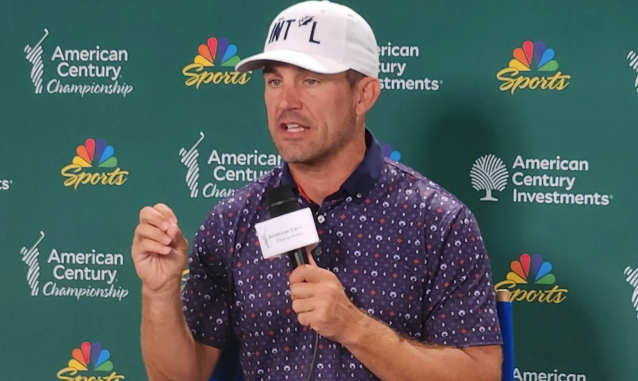
At Stateline, Nevada, during a Wednesday press conference held in the Edgewood Tahoe Resort’s media room ahead of the 2026 American Century Championship, Taylor Twellman voiced strong concerns about the state of U.S. men’s soccer. Twellman, who is among the 90 celebrities set to compete in NBC’s televised golf tournament airing across NBC, NBC Sports Network, and Peacock from July 10–12, had already been addressing the importance of the 17–21 age bracket in response to an earlier question. In his view, that specific age range is precisely where the U.S. falls behind powerhouse nations like France, Spain, England, and Argentina. Without producing generational figures akin to Kylian Mbappé or Lionel Messi, Twellman argued, the U.S. must instead rely on having two or three players deep at every position to remain competitive internationally something he believes is currently unattainable given the structure of American youth sports.
According to Twellman, the U.S. simply cannot field multiple versions of players like Christian Pulisic, Folarin Balogun, or Weston McKennie on a single roster under the existing youth system. Soccer, he pointed out, has increasingly become a business, and that business model actively restricts access for young talents who lack financial resources. That exclusivity, he said, is what creates the measurable gap on the global stage. When I asked Twellman what role major college athletic conferences specifically the SEC, Big Ten, and ACC could play in addressing this before the 2034 World Cup (since 2030 is too soon for meaningful cultural shifts), he acknowledged that these conferences, along with the Big 12, dominate NIL spending and could potentially mimic college basketball by recruiting international talent, though that would require outbidding foreign clubs used to such financial battles.

Twellman responded at length, placing blame on conference leadership and Title IX for the neglect of men’s collegiate soccer, which he sees as having a cascading effect on the national team. He criticized the NCAA for treating soccer with disregard, pointing to the absurdity of playing over 20 matches in just three months while other sports have had their schedules and rules adapted over time. He noted that his father played the same college schedule two decades before him, underscoring how little has changed. While he acknowledged that the NCAA is finally considering adjustments, he insisted that more games are essential. He also mentioned that international scouts consistently tell him that the U.S. falls behind precisely in that 17-to-21 window, where players abroad are logging meaningful minutes. He used Jamie Vardy as an example of a player who would have been discarded early in the U.S. system but was discovered later in his career abroad.

Twellman further argued that college soccer could be part of the solution if it became more cost-effective, avoided hiding behind Title IX and football budgets, and allowed for a longer season. He stressed the value of combining education with athletic development but insisted that the NCAA must show soccer the same respect it has shown other evolving sports by modernizing its rules. However, he acknowledged the steep hierarchy in college athletics, where men’s soccer sits behind football, men’s and women’s basketball, baseball, softball, and women’s soccer in terms of priority. Without a significant shift in investment from conferences, university presidents, and athletic directors, or fundamental changes in youth soccer accessibility, Twellman implied that the same frustrations surrounding the USMNT will persist through 2030, 2034, and beyond a takeaway that resonated clearly from his response.
Leave a Reply