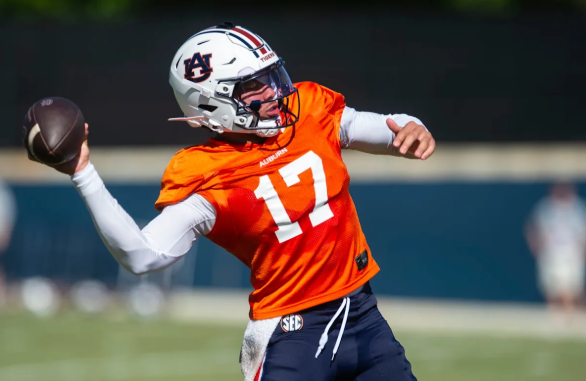
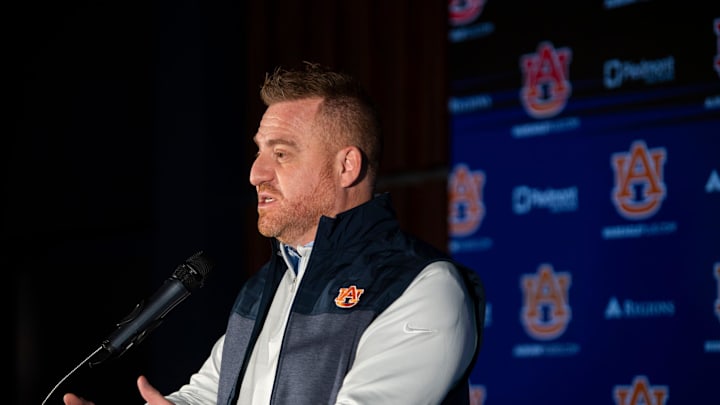
AUBURN, Ala. — When Alex Golesh stepped into his role as head coach of the Auburn Tigers, he inherited a program that had become synonymous with instability and underachievement. After five consecutive losing seasons a streak not seen on The Plains since the 1940s the task ahead of the new coach is nothing short of a program revival .
Auburn’s recent history paints a stark picture. The Tigers have not posted a winning season since 2020, the year Gus Malzahn was dismissed despite a 6-4 record against an all-SEC schedule . Since then, the program has cycled through head coaches at an alarming rate, with Golesh becoming the fifth head coach in just six years .
The frustration has been compounded by a series of agonizingly close defeats. Auburn has lost 12 of its last 13 one-score games, a statistic that underscores the program’s inability to execute in critical moments . In 2025, the Tigers were statistically identified as the “unluckiest team in college football” by CBS Sports, having suffered multiple losses despite winning the turnover battle .
The nadir came in November 2025, when a 27-20 Iron Bowl loss to Alabama sealed Auburn’s fifth straight losing season . The Tigers have not defeated their bitter rival since 2019, and the six-year Iron Bowl drought has become a symbol of the program’s broader struggles .
Perhaps the most telling sign of Auburn’s instability is the dramatic roster overhaul that has taken place under Golesh. The Tigers returned just one starter from the 2025 team: running back Jeremiah Cobb . This staggering turnover places Auburn second in the SEC for incoming transfers with 46 .
The offense has been almost entirely reconstructed. Quarterback Byrum Brown, who transferred from USF with Golesh, heads a revamped quarterback room after posting 7,690 passing yards and 2,265 rushing yards across four seasons with the Bulls . The receiving corps has been similarly transformed, with the “Freeze Four” replaced by a group of USF transfers dubbed “Golesh’s Guys” . The offensive line has been rebuilt from scratch after all six starters departed, creating a significant question mark .
Despite the challenges, there is a palpable sense of optimism surrounding Golesh’s arrival. His track record suggests he may be uniquely equipped to address Auburn’s core issues. At Tennessee, he served as offensive coordinator for offenses that ranked No. 1 nationally in scoring (46.1 points per game) and total yards (525.5 yards per game) in 2022 . At USF, he built a program that finished No. 2 nationally in total offense in 2025 .

Golesh has emphasized a collaborative approach to play-calling, with offensive coordinator Joel Gordon taking the lead . “There’s so much conversation in between drives,” Golesh explained during his introductory press conference. “It’s as truly a collaborative effort as you could ever imagine… ultimately the guy calling the plays, it’s on him to get us in the right spot” .
Central to Golesh’s philosophy is a commitment to the running game. “We’re gonna run the heck out of the ball,” he stated. “That’s where it all starts offensively for us. You gotta be able to run the football. And I don’t care what league you’re in, you need backs that can run the ball” . The Tigers will lean on returning starter Jeremiah Cobb, Baylor transfer Bryson Washington, and a committee of backs to establish this identity .
Golesh has also demonstrated a willingness to adapt a quality that may prove essential in the SEC. Reflecting on his time at Tennessee, he noted that the offense had to evolve to compete in the conference. “Heup’s biggest thing was ‘Hey, everything we’ve just done [at UCF], if we don’t change, we’re gonna get blown up,'” Golesh recalled . This lesson has informed his approach at Auburn: “You can’t get here by not being able to evolve. I think people, specifically media, want to compartmentalize what you do offensively… I’ve never once thought of it as veer-n-shoot” .
His system is built on creating mismatches and using tempo to force defenses to adjust rather than the other way around . “The foundation of it is everything starts with the run,” Golesh explained. “We use the entire width of the field. We’ll condense it. We’ll expand it. And we use tempo to our advantage” .
The 2026 season will be a critical test of whether Golesh can reverse Auburn’s fortunes. ESPN’s Football Power Index places the Tigers at No. 22 nationally, projecting them to finish with 6.6 wins . The schedule includes a challenging stretch of Tennessee, Georgia, LSU, and Ole Miss, followed by winnable games against Arkansas and Mississippi State that could build momentum before the Iron Bowl .
The biggest vulnerability remains the offensive line, which ranks 14th among 16 SEC programs in preseason evaluations . Analysts have described the unit as a “hodgepodge” of transfers, with only one lock starter in USF transfer Cole Best . Golesh has addressed this through recruiting the 2027 class already includes four offensive line commits but immediate results will depend on how quickly this cobbled-together unit can develop cohesion .
Auburn has been a program searching for identity since the departure of Gus Malzahn. The failures of Bryan Harsin and Hugh Freeze demonstrated that talent alone cannot overcome a lack of coherent leadership and vision . The influence of powerful boosters and the program’s tendency to measure itself against rivals rather than build its own identity have compounded the instability .
As Golesh begins his tenure, the question is whether he can provide the stability and direction that has eluded Auburn for half a decade. His offensive track record, collaborative approach, and SEC experience from his time at Tennessee offer reasons for optimism. But the path forward will require addressing the program’s core weaknesses — particularly the offensive line and breaking the pattern of heartbreaking losses that has come to define Auburn football.
If Golesh can succeed where his predecessors have failed, he may finally return Auburn to postseason contention. If not, the Tigers risk extending a streak of losing seasons that has already reached historic proportions. The 2026 season will be the first opportunity to find out which path this storied program will take.
Leave a Reply